Types of Surgical Instruments
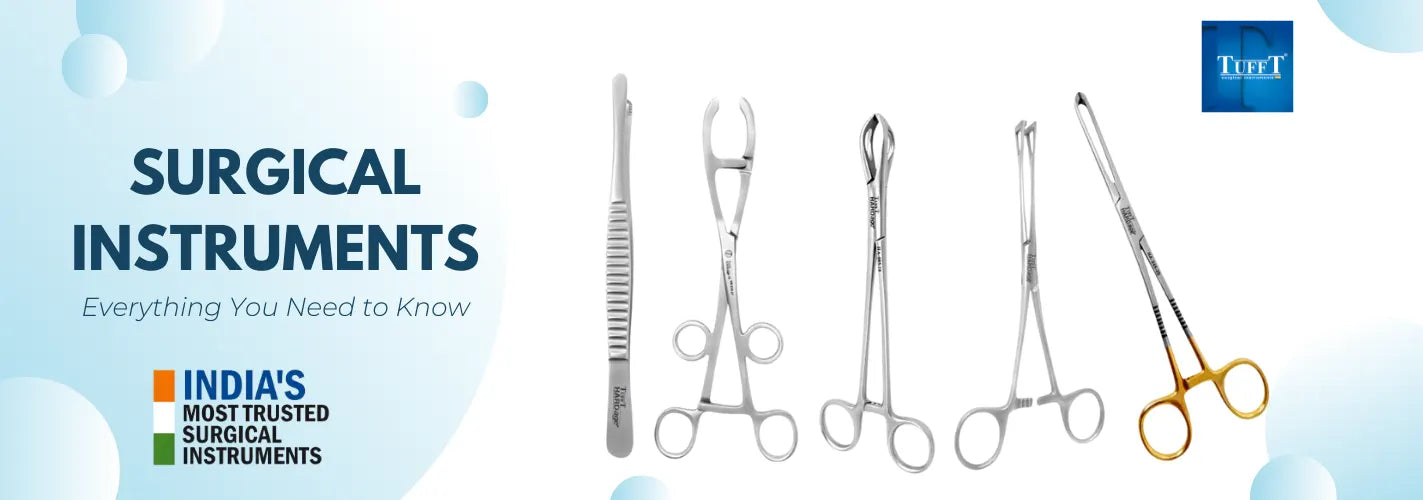
Surgical procedures rely on a wide range of surgical instruments and medical equipment to ensure precision, efficiency, and patient safety. Understanding these instruments - from basic operation tools for surgery to specialized instruments - is essential for healthcare professionals and institutions looking to shop for medical equipment or stock high-quality surgical equipment in India or beyond.
In this blog, we break down the major types of surgical instruments used in operating rooms globally, along with their typical uses, examples, and how they contribute to successful surgeries.
Types of Surgical Instruments
1. Cutting & Dissecting Instruments
Cutting and dissecting instruments are used in surgery to create an incision or to separate tissue (surgical instruments to make incisions).
-
Scalpels: Sharp blades used for precise incisions.
-
Scissors: Designed to cut tissues, sutures, or dressings; common types include Mayo scissors and Metzenbaum scissors.
2. Grasping & Holding Instruments
Grasping/holding instruments are used by the surgeon to grasp, stabilise, and manipulate tissues/organs while operating.
-
Forceps: Resemble tweezers and are available in ratcheted and non-ratcheted designs.
-
Tissue forceps: For handling delicate tissues without damage.
3. Needle Holders
One of the main purposes of needle holders is to provide the ability to securely hold a suture needle while closing off or suturing tissue or a wound. Needle holders are usually used in nearly all types of surgery.
4. Clamps & Hemostatic Instruments
These operating instruments control bleeding and secure blood vessels or tissues during surgery. Hemostatic clamps help achieve hemostasis, which is crucial for maintaining clear visibility and ensuring safety in the surgical field.
5. Retractors and Exposure Tools
Retractors assist in allowing doctors a better view of their working area by keeping back muscles, organs, and tissues.
6. Specialty Instruments
Some surgical procedures will require special instrument sets called specialty instruments. These instruments have been specifically engineered for purposes beyond general surgical use; some examples of such instruments include laparoscopy instruments, probe and dilator sets, curettes, etc.
7. Gynaecology Instruments
In obstetrics and gynaecology, specialized tools help with exams, deliveries, and procedures. Examples of gynaecology surgical instruments include specula, dilators, retractors, and more.
8. Other Essential Medical Surgical Equipment
There are other types of surgical equipment besides the primary instrument sets listed above. These include suction canisters and tubes, cannulae, trocars, probes, and measuring devices, all of which play a very important role in ensuring that a surgery is performed safely and correctly.
Why Quality Matters?
Quality is an important consideration in the selection of surgical instrumentation. Surgical instruments must be manufactured from high-quality materials, such as surgical stainless steel, which enables the instrument to withstand repeated sterilization and provides long-term durability. The importance of having reliable and durable surgical equipment cannot be overstated.
When looking for high-quality medical instruments and equipment in India, consider TUFFT. TUFFT offers a large selection of high-quality and reliable medical instruments and surgical tools to choose from. Learn more about the brand here.
FAQ
1. What are the basic types of surgical instruments?
The basic classification of surgical instruments can be divided into three categories: cutting and dissecting instruments, graspers and holders, and needle holders/clamps.
2. What’s the difference between forceps and clamps?
A pair of forceps is usually used to grip or manipulate tissue or other objects. Clamps can provide a locking mechanism to help stabilize blood vessels or tissue to help stop bleeding from occurring during surgery.
3. What are hardage scissors used for?
Hardage scissors are used for cutting tissues and materials such as sutures or dressings during surgery, offering high precision and durability.
4. Why do we need high-quality surgical instruments?
A well-designed surgical instrument will provide the surgeon with a high degree of accuracy while sterilizing their surgical instruments and will be more durable than other instruments.
5. Can I find all types of operation instrument sets in one place?
Yes, you can shop a wide range of surgical instruments and medical surgical equipment from dedicated surgical suppliers like TUFFT, especially if you’re in India or sourcing for clinical use.

Team TUFFT is the editorial and expert content team behind TUFFT, dedicated to sharing insights, innovations, and industry knowledge in the field of surgical and medical instruments. Backed by experienced professionals, skilled engineers, and a commitment to quality, Team TUFFT creates informative content focused on surgical excellence, healthcare advancements, and precision manufacturing.