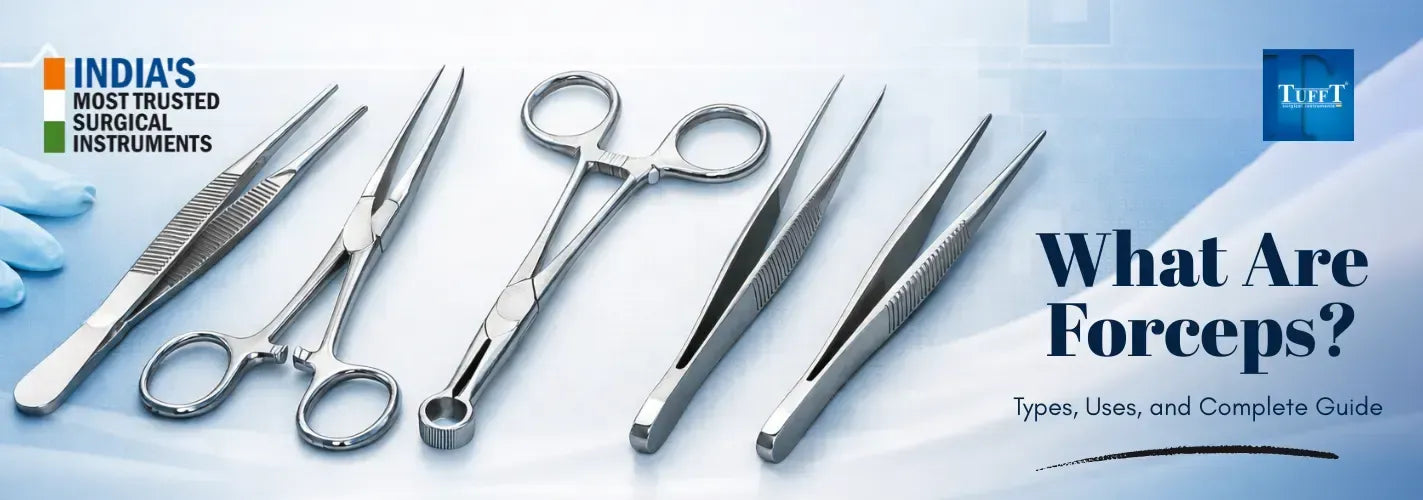
What Are Forceps? Types, Uses, and Complete Guide
If you've ever stepped into an operating room, the first thing that hits you is how many instruments are waiting on that tray. Forceps take up half that space. They're probably the most versatile tool a surgeon touches all day. Whether it's holding tissue still, stopping bleeding, or manipulating something deep inside a body cavity, forceps do the work. But here's the thing that catches a lot of people off guard, there's no such thing as "just grabbing a forceps." Each type was designed for something specific.
I've watched surgeons work for years, and the ones who move fastest aren't rushing. They're using exactly the right instrument for exactly the right moment. That's where knowing your forceps types makes all the difference.
What Are Forceps?
Forceps are surgical instruments with two hinged handles and opposing jaw tips. They're used to grasp, hold, clamp, and manipulate tissue during medical procedures. The design is simple but the variations are huge. Some lock down solid with a ratchet. Others stay loose so you can move tissue around. Some have sharp serrated teeth. Others have smooth jaws. Each variation solves a specific problem in the operating room.
The word comes from Latin meaning "to grip." That's exactly what they do. But the way they grip, the strength of that grip, and what they're gripping changes everything. A forceps designed for holding delicate eye tissue would tear the bowel. A forceps designed for clamping blood vessels would crush a nerve. That's why there's so many different types.
Types of Forceps Based on Usage
1. Allis Forceps
Walk into any general surgery room and you'll see Allis forceps on nearly every tray. These are the workhorses. They have interlocking serrated teeth with a ratchet that locks down solid. That design means they grip tissue firmly without slipping. You need to hold fascia, muscle, or any tough tissue in place while working around it. Allis forceps are your answer.
Once you clamp an Allis down, it stays clamped. You're not fighting with it. Allis tissue forceps come in different sizes. Smaller versions for more delicate control. Bigger ones for heavy lifting. Same principle, different scale.
2. Adson Forceps
Adson forceps are the opposite end of the spectrum. These are for when you're working with tissue that'll show every mark you make. Plastic surgeons practically live with these in their hands. They come with serrated teeth or smooth versions.
Grab the serrated Adson when you need grip on delicate skin edges. Switch to smooth when you're working on something that bruises easily or where cosmetic outcome matters. The jaw is narrower and more precise. You're positioning something with control, not clamping down hard. Adson tissue forceps sit on almost every plastic surgery tray where precision matters more than force.
3. Artery and Hemostatic Forceps
Here's where bleeding stops. Artery forceps, also called hemostats, clamp vessels tight. You've got options depending on vessel size. The tinyBaby Mosquito Hartmann artery forceps handle the smallest bleeds.Larger ones like Spencer Wells artery forceps work on bigger vessels.
The ratchet mechanism is key. Clamp it down and your hands are free. Maybe cautery. Maybe tie it off. You're not holding pressure like you would with fingers. The hemostat does that work. Most surgeries use several hemostats at the same time. That's normal procedure.
4. Tissue Dissecting Forceps
Not every instrument needs a lock. Dissecting forceps are lighter, simpler. You hold them like a pen. No ratchet. Just jaw action. These are what you use when you need to move something, turn it, look at it from different angles. They hold without squishing.
The standard dissecting and tissue forceps come straight and curved. Straight ones work in accessible areas. Curved ones let you reach deeper without your hand getting in the way. They're simple because they need to be. You want to put them down and pick them up repeatedly without thinking.
5. Babcock Forceps
Babcock forceps hold delicate structures without crushing them. They have curved jaws that cup tissue gently. Instead of sharp teeth, these have a smoother gripping surface.
Use these when you need to move something fragile. Bowel. Fallopian tubes. Anything that would tear if grabbed hard. The Babcock cups it, holds it steady, and you manipulate it however needed. The tissue underneath doesn't get traumatized. Babcock tissue holding forceps are standard in abdominal and gynecology procedures.
6. Specialized Gynecology Forceps
Obstetrics and gynecology have their own forceps. Uterine vulsellum forceps grip the cervix or uterus with sharp teeth to secure it. Gynecologists know their instruments like musicians know their instruments. Every forceps was designed for a specific job.
Straight vs. Curved Handles
Straight handled forceps give you direct access to something nearby. Curved handles let you reach deeper without your hand getting in the way. Some forceps come in both versions. Different handles, same jaw design. Surgeons who use a particular forceps a lot usually have a preference based on feel and reach.
Why does TUFFT Matters?
You can get cheap forceps. They're terrible. The jaw won't align properly. The ratchet gets sticky after sterilization cycles. The teeth are smooth. Then you're struggling in the middle of a procedure with an instrument that won't work right.
TUFFT builds forceps that perform. High grade stainless steel survives autoclaving hundreds of times. Jaw alignment stays tight. Ratchets click with a consistent feel. When you pick up a TUFFT forceps, you know what to expect. That reliability becomes invisible when working.
Hospitals figure this out over time. They start buying cheaper instruments. Within a year they're replacing them. Within two years they've spent more than buying decent ones at the start. TUFFT prices are fair for what you get.
FAQ
1. What are surgical forceps used for?
Holding tissue, stopping bleeding, and manipulating structures during surgery.
2. What's the difference between Allis and tissue forceps?
Allis has interlocking teeth and locks down hard. Tissue forceps are lighter, more for dissecting.
3. When do you use hemostatic forceps?
When you need to clamp a bleeding vessel and keep both hands free for other work.
4. Are Adson forceps good for all surgeries?
No. They're precision instruments for delicate work, not heavy tissue handling.
5. Can you reuse surgical forceps?
Yes. They get autoclaved and reused constantly. Quality matters for durability.
6. What's the price range for decent forceps?
Basic tissue forceps run 500 to 1500 rupees. Specialized instruments cost more.
7. Why does jaw alignment matter so much?
If the jaws don't close properly, the instrument won't grip and you lose control.
8. Should I buy individual forceps or sets?
Sets make sense when building a basic tray. Individual purchases for specific needs.
9. What materials are in good surgical forceps?
Surgical grade stainless steel. Some use tungsten carbide inserts for durability.
10. Where do I buy quality forceps?
TUFFT has a huge selection with everything from basic to specialized instruments.

Team TUFFT is the editorial and expert content team behind TUFFT, dedicated to sharing insights, innovations, and industry knowledge in the field of surgical and medical instruments. Backed by experienced professionals, skilled engineers, and a commitment to quality, Team TUFFT creates informative content focused on surgical excellence, healthcare advancements, and precision manufacturing.