Article: Needle Holders in Microsurgery: The Complete Guide
Needle Holders in Microsurgery: The Complete Guide
Microsurgery leaves very little room for error. When a surgeon is working with extremely small vessels, nerves, or delicate soft tissue, even a slight movement can affect needle placement. This is why the needle holder is more than a basic surgical instrument. In microsurgery, it becomes an extension of the surgeon’s fingers, helping control the needle, direction, rotation, and depth of each stitch.
Unlike conventional suturing, microsurgical procedures often use very fine needles and sutures. A suitable holder must therefore provide precise control without applying excessive force to the needle or surrounding tissue. Microsurgical references describe specialized micro needle holders alongside micro forceps and micro scissors as essential instruments for delicate procedures.
This needle holders guide explains how microsurgical needle holders work, the main designs available, how they differ from standard surgical models, and what to consider when selecting one.
What Is a Microsurgical Needle Holder?
A needle holder, also known as a needle driver or needle holding forceps, is designed to securely grasp a surgical needle and guide it through tissue during suturing.
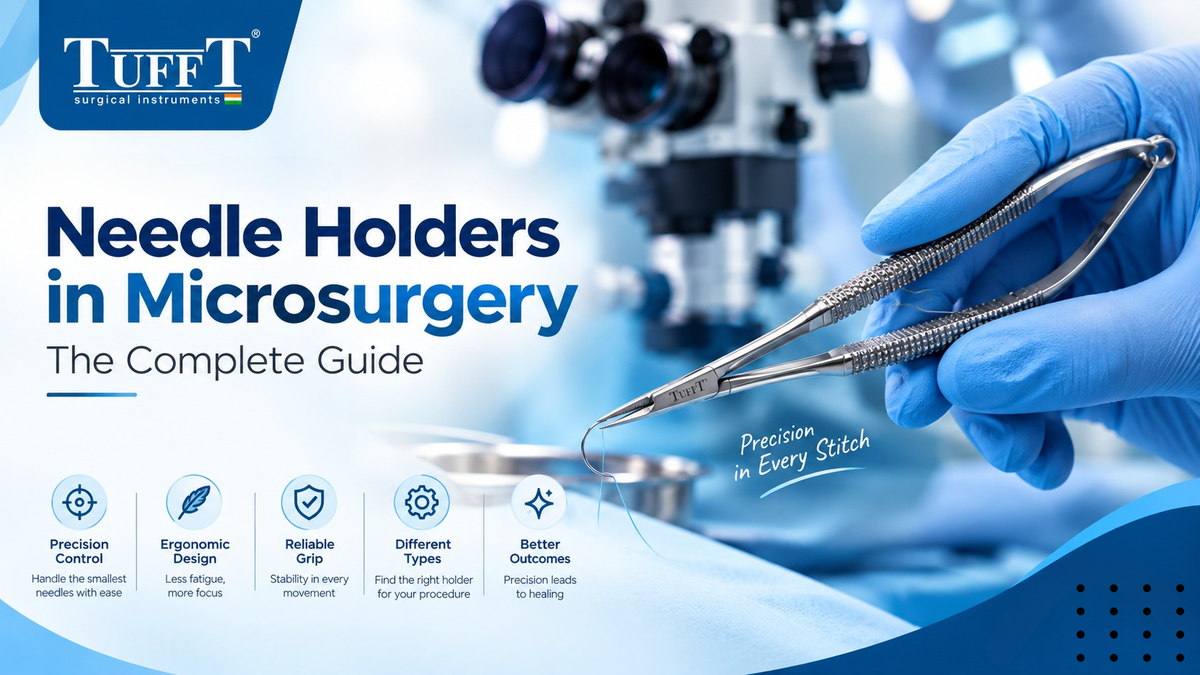
A conventional needle holder commonly has short gripping jaws, a hinged joint, handles, and sometimes a ratchet mechanism. Microsurgical models take the same basic principle but refine it for smaller needles and more controlled movements. Fine-jawed, spring-handled designs such as Castroviejo holders are commonly associated with microsurgical and ophthalmic work.
The objective is not simply to hold the needle tightly. The instrument should allow the surgeon to rotate and advance the needle smoothly while maintaining a stable grip.
That distinction matters. Excessive jaw pressure can deform or damage a fine needle, while insufficient grip may allow the needle to rotate unexpectedly.
Why Needle Holders Matter in Microsurgery
In standard surgery, the instruments are often designed around relatively larger needles and sutures. Microsurgery demands much finer control.
During procedures such as microvascular anastomosis, the surgeon may work under magnification with extremely small structures. A micro needle holder helps translate controlled finger movements into precise needle movement. Microsurgical training resources specifically identify the micro needle holder as the instrument used to drive the needle during these procedures.
The handle design is particularly important. Many microsurgical holders use a pencil-like or spring-handle grip rather than the finger rings found on traditional holders. This gives the surgeon more direct fingertip control and supports delicate rotational movements.
Key Features of a Good Microsurgical Needle Holder
Fine, Precise Jaws
The jaws should be capable of gripping a small needle securely without crushing it. Parallel jaw closure and an appropriately textured working surface can help maintain control over fine needles and suture material.
The jaw profile should also match the intended needle size. Using a delicate micro holder for an oversized needle can damage the instrument.
Ergonomic Handle
Microsurgical procedures can take considerable time. A poorly balanced instrument can contribute to hand fatigue and make fine movements more difficult.
A well-designed microsurgical needle holder should feel balanced in the hand and allow small movements without requiring excessive pressure. Spring-handle and pencil-grip designs are widely used because they support fingertip manipulation.
Locking Mechanism
Not every needle holder needs a ratchet. In conventional surgery, a ratchet can maintain a secure grip on the needle without continuous squeezing. Mayo-Hegar needle holders are a familiar example.
Microsurgery is different. Ratchetless holders are commonly preferred because locking and unlocking can create unwanted movement at the tips. This is particularly important when working around fragile vessels.
Common Needle Holder Types: Where Do They Fit?
Not every needle holder instrument is intended for microsurgery. Understanding the differences between designs helps prevent inappropriate instrument selection.
Castroviejo Needle Holders
Castroviejo needle holders are strongly associated with microsurgical, ophthalmic, periodontal, and fine dental procedures. Their spring-style handle and fine jaws provide fingertip control for delicate suturing.
They are particularly useful where small needles, narrow working spaces, and precise movements are involved.
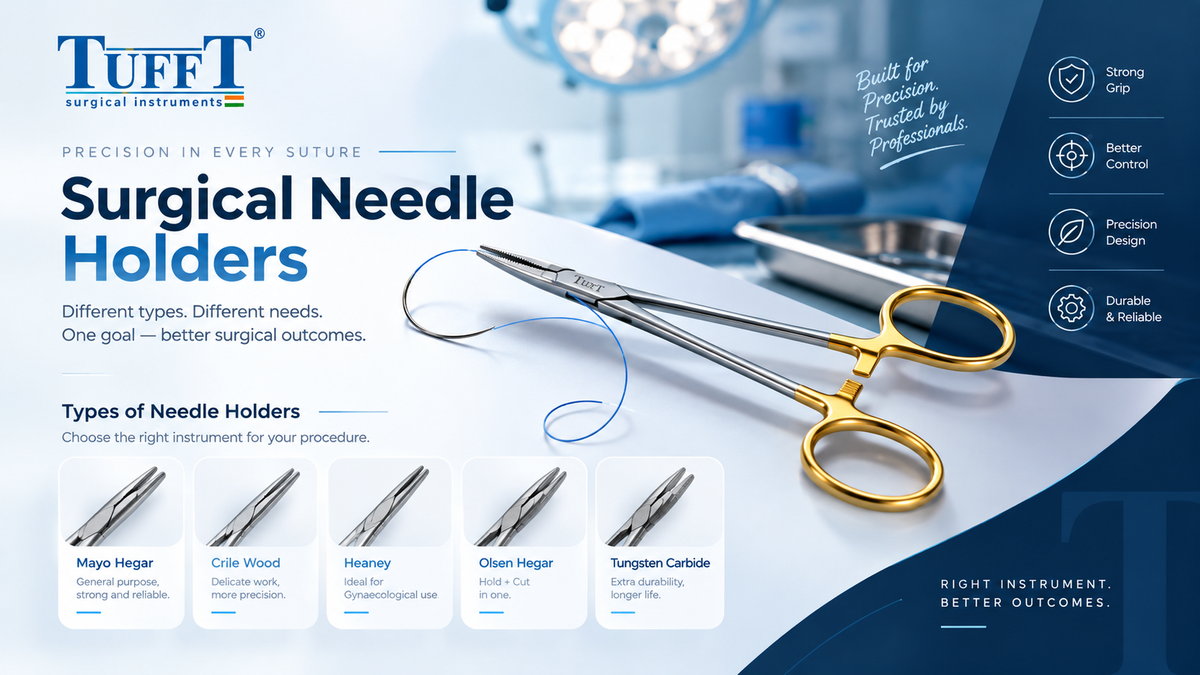
Mayo Hegar Needle Holders
Mayo Hegar needle holders are traditional ring-handled instruments with a ratchet mechanism. They are robust and commonly used for general surgical suturing, particularly with medium and larger needles.
A Mayo needle holder is therefore better viewed as a general-purpose surgical option rather than a dedicated microsurgical instrument. TUFFT currently lists Mayo-Hegar models in several lengths, including 15 cm, 18 cm, and 20 cm.
Crile Wood Needle Holder
A Crile Wood needle holder has a more slender profile than many conventional holders and can be useful where access and visibility are important. It is commonly found in surgical and dental instrument sets.
For dental applications, the choice between Mayo-Hegar, Crile-Wood, and Castroviejo should be based on the procedure, suture size, working space, and the operator’s preferred handling characteristics rather than simply choosing the most familiar design.
Specialty and Combination Holders
Some holders combine suturing and cutting functions. For example, Olsen-Hegar-type instruments incorporate scissors, while TUFFT also offers a Gillies needle holder with scissors. Such combination instruments can reduce instrument changes during suitable procedures.
Terms such as hardage scissors may also appear in searches for surgical scissors and related instrumentation, but scissors and needle holders have distinct primary functions. A needle holder should be selected for reliable needle control rather than treated as a substitute for a dedicated cutting instrument.
Needle Holders for Surgical and Dental Procedures
The requirements of dental suturing can vary considerably. General oral surgery may call for a conventional ring-handled holder, while periodontal or microsurgical procedures may benefit from a fine, pencil-grip design.
This is where needle holders surgical dental selection becomes important. The needle diameter, suture thickness, tissue type, access, and required precision should all influence the choice.
A practical rule is simple: match the holder to the needle and procedure. Fine sutures require delicate control, while heavier needles need a holder designed to withstand the required gripping force.
How to Choose the Right Needle Holder
Before selecting a holder, consider these factors:
1. Needle size: The jaws must suit the needle being used. Avoid using micro instruments with needles that are too large.
2. Suture size: Fine sutures generally require finer jaw geometry and more controlled handling.
3. Procedure: General surgery, dental surgery, ophthalmology, vascular surgery, and microsurgery may require different designs.
4. Handle preference: Decide whether a ring-handled, palm-grip, or spring-handle instrument provides the control needed for the procedure.
5. Jaw material and finish: Tungsten carbide or other specialized gripping surfaces can provide durability and reliable needle engagement in appropriate designs. TUFFT, for example, offers TC-insert Mayo-Hegar models.
6. Maintenance: Inspect the jaws, joint, and locking or spring mechanism regularly. Proper cleaning, sterilization, drying, and instrument handling are essential for maintaining performance.
Why Proper Instrument Selection Matters
A needle holder may look like a simple pair of surgical forceps, but its dimensions, jaw geometry, balance, and mechanism can significantly affect handling.
The right instrument should allow the surgeon to concentrate on tissue approximation rather than fighting the tool. It should grip the needle consistently, release smoothly, and remain comfortable during repeated suturing.
For conventional surgical work, robust designs such as Mayo-Hegar or Crile-Wood may be appropriate. For true microsurgical work, fine spring-handled or specialized micro needle holders are generally more suitable.
Explore Surgical Needle Holders from TUFFT
TUFFT provides a range of surgical needle holders, including Mayo-Hegar, Crilewood, Heaney, Bozemann, Ryder vascular TC, and Gillies needle holders with scissors.
You can explore the available needle holders collection, or read TUFFT’s resources on surgical needle holders, needle holders for surgical and dental use, and the needle holders guide.
For product or instrument-related enquiries, you can also contact TUFFT.
FAQs
1. What is a needle holder used for in microsurgery?
A microsurgical needle holder is used to grip and guide very fine needles during delicate suturing. Its design allows controlled needle rotation and movement while working under magnification.
2. Are Mayo-Hegar needle holders suitable for microsurgery?
Mayo-Hegar holders are primarily general surgical instruments with ring handles and ratchet mechanisms. Dedicated microsurgical procedures generally require finer instruments designed specifically for small needles and delicate tissue.
3. What is the difference between a needle holder and needle holder forceps?
The terms are often used interchangeably. Both describe instruments designed to grasp and manipulate a surgical needle during suturing. However, specialized microsurgical needle holding forceps may have spring handles and finer jaws.
4. Can a microsurgical needle holder be used with large needles?
It should not be assumed to be safe. Micro needle holders are designed for fine needles, and using an oversized needle can place excessive force on delicate jaws and potentially damage the instrument.
5. Which needle holder is commonly used for dental microsurgery?
Fine Castroviejo-style needle holders are commonly associated with periodontal and microsurgical dental procedures, while Mayo-Hegar and Crile-Wood designs are used for broader surgical and dental suturing applications. The appropriate choice depends on the needle, suture, procedure, and operator preference.

Team TUFFT is the editorial and expert content team behind TUFFT, dedicated to sharing insights, innovations, and industry knowledge in the field of surgical and medical instruments. Backed by experienced professionals, skilled engineers, and a commitment to quality, Team TUFFT creates informative content focused on surgical excellence, healthcare advancements, and precision manufacturing.