Article: Needle Holders vs Forceps: Differences, Uses, and When to Use
Needle Holders vs Forceps: Differences, Uses, and When to Use
In a surgical setting, even instruments that look similar can serve very different purposes. Needle holders and forceps are two essential examples. Both help surgeons maintain control during procedures, but using the right instrument for the right task makes a difference to precision, handling, and tissue protection.
For medical students, dental professionals, surgical teams, and hospital procurement managers, understanding these differences is important when selecting instruments for a clinical setting. This needle holders guide explains how the instruments work, where each is used, and what to consider when choosing between them.
What Is a Needle Holder?
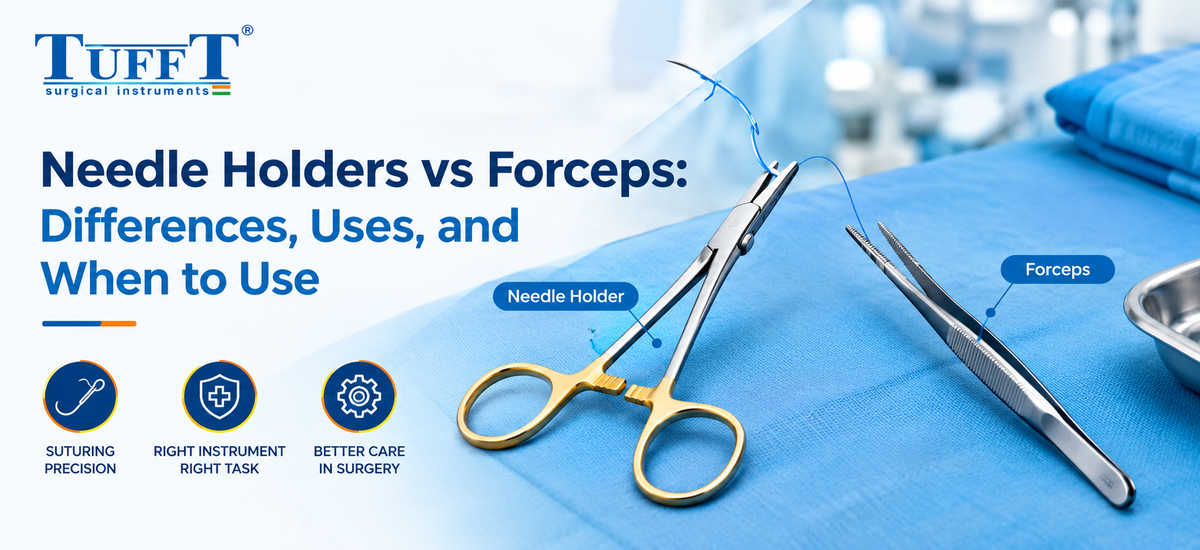
A needle holder is a surgical instrument designed to grip and guide a suturing needle through tissue during wound closure. It allows the surgeon to control the needle's angle and movement without holding it directly with the fingers.
Most conventional needle holders have two handles, a hinged joint, short gripping jaws, and a locking mechanism. Their jaws are designed to maintain a firm grip on the needle as it passes through tissue. Some models also feature tungsten carbide inserts for enhanced gripping performance and wear resistance.
Common applications include closing surgical incisions, suturing wounds, and repairing soft tissue after dental procedures. The appropriate instrument depends on the needle size, tissue involved, working space, and procedure.
What Are Surgical Forceps?
Surgical forceps are instruments used to grasp, hold, lift, or manipulate tissue and other materials during medical procedures. Unlike needle holders, forceps cover several instrument types, each designed for a particular task.
For example, tissue forceps help surgeons handle wound edges, while hemostatic forceps clamp blood vessels to assist with bleeding control. Dressing forceps are used to handle dressings or other materials, depending on their design and intended application.
In dental surgery, forceps can help manipulate soft tissue and support access to the surgical site. Selecting the correct type is important because the jaw design and gripping pressure must suit the structure being handled.
Needle Holders vs Forceps: Key Differences
Although some instruments share ring handles, hinges, and locking mechanisms, their working ends are designed for different purposes.
|
Feature |
Needle Holder |
Surgical Forceps |
|
Primary function |
Holds and guides suturing needles |
Grasps, lifts, or manipulates tissue and materials |
|
Jaw design |
Generally short and robust |
Varies by instrument and intended use |
|
Gripping surface |
Designed to stabilize a needle |
May be smooth, toothed, or serrated |
|
Locking mechanism |
Common in ring-handled models |
Depends on the type of forceps |
|
Typical applications |
Suturing and wound closure |
Tissue handling, dressing, or clamping |
|
Examples |
Mayo-Hegar, Mayo needle holder |
Adson, dressing, and hemostatic forceps |
The central distinction is straightforward: needle holders control the needle, while forceps perform different grasping or holding tasks. Hemostatic forceps should not be confused with tissue forceps, as their primary purpose is to clamp vessels or other structures.
Customer Success Story: Dr. V. P. Paily and TUFFT Surgical Instruments
Customer: Dr. V. P. Paily
Specialty: Obstetrics and Gynaecology
Company: TUFFT Surgical Instruments
When precision matters in the operating theatre, the right surgical instrument can make a meaningful difference to a healthcare professional's work. Dr. V. P. Paily, a Senior Consultant in Obstetrics and Gynaecology, shared his experience of associating with TUFFT Surgical Instruments during the development of a Transvaginal Uterine Artery Clamp, designed for controlling postpartum haemorrhage.
His association with TUFFT also gave him the opportunity to observe other instruments, including retractors and sponge-holding forceps. His feedback highlighted the instruments' finishing and quality, reflecting the importance of thoughtful instrument design in specialised medical applications.
For TUFFT, this association represents the value of working closely with medical professionals and understanding the practical requirements of surgical practice. With its focus on Design, Accuracy, and Quality, TUFFT continues to serve healthcare professionals seeking surgical instruments for a range of clinical specialties.
Different Types of Needle Holders and Their Uses
Choosing a needle holder involves more than selecting a familiar name. Instrument size, jaw construction, and the type of suturing required all influence suitability.
1. Mayo-Hegar Needle Holders
Mayo Hegar needle holders are widely recognized general-purpose instruments used for suturing in various surgical specialties. Their ring handles and locking mechanism help maintain a secure needle grip during wound closure.
They are available in different lengths to suit the working depth and needle size. Before selecting a model, clinicians should consider whether its jaw dimensions and grip characteristics match the intended procedure.
2. Mayo Needle Holder
The term Mayo needle holder is commonly used when referring to Mayo-style needle-holding instruments, although product naming can vary between manufacturers and catalogues. Buyers should verify the exact model, dimensions, and jaw specifications rather than relying on the name alone.
A suitable model should provide controlled needle handling without unnecessary bulk or restricted movement.
3. Dental Needle Holders
Needle holders surgical dental professionals use are selected according to the small working area, suturing requirements, and access needed within the oral cavity. Compact models can be useful for procedures requiring controlled movements around delicate oral tissues.
The right choice depends on the procedure and the clinician's preferred technique. A needle holder intended for general surgery may not offer the most convenient handling for every dental application.
When Should You Use a Needle Holder Instead of Forceps?
The choice becomes easier when you consider the task being performed.
Use a needle holder when:
-
Passing a suturing needle through tissue.
-
Closing a wound after a surgical procedure.
-
Placing sutures following dental or oral surgery.
-
Maintaining controlled needle positioning in a restricted surgical field.
Use the appropriate forceps when:
-
Holding wound edges during suturing.
-
Lifting or manipulating tissue for better access.
-
Handling dressings or other materials.
-
Clamping blood vessels when a suitable hemostatic instrument is required.
During wound closure, both instruments may be used together. The needle holder guides the needle, while tissue forceps help position the wound edges. This coordinated approach supports controlled suturing without asking either instrument to perform a job it was not designed for.
How to Choose the Right Surgical Instrument
For clinical teams and procurement professionals, the following considerations can help narrow down the options.
Match the instrument to the procedure. Consider the type of tissue, required working depth, needle dimensions, and available operating space before selecting a model.
Inspect jaw alignment and grip. The jaws should meet correctly, and the locking mechanism should engage and release smoothly. Damaged or misaligned gripping surfaces may affect handling.
Consider material and construction. Reusable instruments should be suitable for their intended application and compatible with the healthcare facility's validated cleaning, disinfection, and sterilization procedures.
Check specifications and documentation. Review the product description, dimensions, material details, and applicable conformity documentation. Procurement teams should confirm that the selected instrument meets their facility's requirements.
Understand related instruments. Instruments such as Hardage scissors serve cutting functions rather than needle holding or tissue grasping. Identifying the intended role of each instrument helps ensure the correct tools are available on the surgical tray.
Caring for Needle Holders and Forceps
Instrument maintenance is an important part of safe clinical practice. After use, reusable instruments should be handled and reprocessed according to the manufacturer's instructions and the facility's established protocols.
Inspect needle holders for worn jaws, poor alignment, loose joints, and faulty ratchets. For forceps, check the tips for damage, bending, or loss of grip. Instruments showing defects should be removed from service and assessed by qualified personnel.
Proper maintenance supports reliable performance and helps extend instrument service life. However, inspection alone does not replace validated cleaning and sterilization procedures.
Choosing Surgical Instruments from TUFFT
When sourcing surgical instruments, healthcare providers should look beyond appearance and price. Product specifications, manufacturing consistency, suitability for the intended procedure, and access to product information all matter.
TUFFT Instruments offers a starting point for exploring surgical instrument options. Buyers can visit the TUFFT website to learn more about the company and its offerings, review the About Us page, or use the Contact page to enquire about product availability and specifications.
Before purchasing, confirm the exact model, dimensions, material, and documentation required for your clinical setting.
FAQ
1. What is the main difference between a needle holder and forceps?
A needle holder is designed to grip and guide a suturing needle, whereas forceps are used for tasks such as holding tissue, handling dressings, or clamping vessels, depending on the type.
2. Where can I buy surgical instruments online?
You can explore and purchase surgical instruments through the official TUFFT website. Browse the available product categories, compare specifications, and contact the TUFFT team for product-related enquiries or assistance with your requirements.
3. Which needle holder is commonly used for general surgery?
Mayo-Hegar needle holders are commonly used for general suturing. The appropriate size and design depend on the needle, tissue, working depth, and procedure.
4. What types of surgical instruments does available in India?
TUFFT offers a range of surgical instruments, including needle holders, forceps, Hardage scissors, retractors, gynaecology instruments, orthopaedic instruments, and general surgical instruments for healthcare professionals and medical facilities.
5. How can you identify a damaged needle holder?
Look for worn or misaligned jaws, unreliable locking, loose joints, corrosion, and difficulty opening or closing the instrument. Any instrument with suspected defects should be removed from use and assessed according to the facility's instrument-management procedures.

Team TUFFT is the editorial and expert content team behind TUFFT, dedicated to sharing insights, innovations, and industry knowledge in the field of surgical and medical instruments. Backed by experienced professionals, skilled engineers, and a commitment to quality, Team TUFFT creates informative content focused on surgical excellence, healthcare advancements, and precision manufacturing.