Article: Needle Holder Uses in Surgery: Types, Handling, and Safety Explained
Needle Holder Uses in Surgery: Types, Handling, and Safety Explained
In surgery, a secure stitch depends on more than the suture material or the surgeon’s technique. The instrument used to guide the needle also plays an important role. A needle holder is a specialised surgical instrument designed to grip a suture needle firmly, allowing controlled movements through tissue during wound closure and other procedures.
Although needle holders may look similar to forceps at first glance, their design and purpose are different. Choosing the right instrument can improve precision, reduce needle slippage and support safer handling. From routine wound closure to delicate microsurgery, understanding the available types and their correct use helps surgical professionals make informed instrument choices.
What Is a Needle Holder Used for in Surgery?
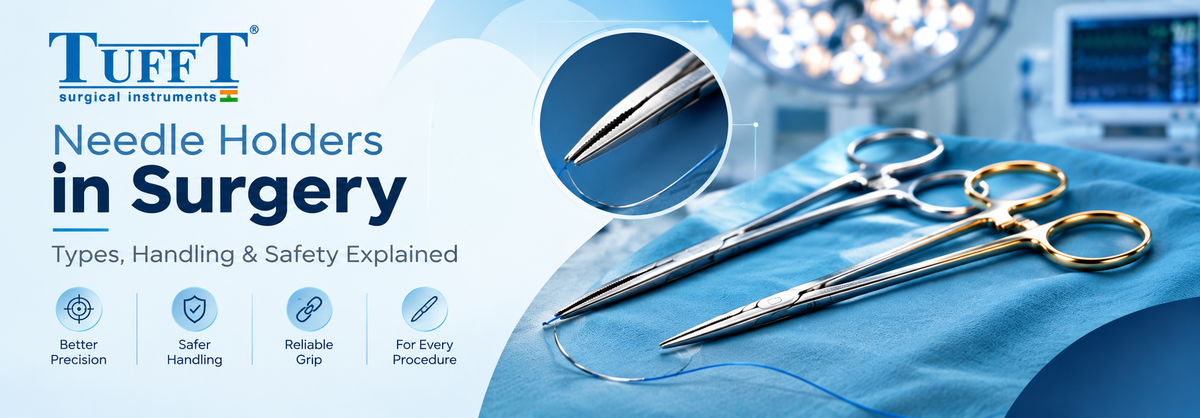
A needle holder, sometimes called needle holder forceps or needle holding forceps, is used to grasp and manipulate a surgical needle during suturing. Most designs feature short, sturdy jaws that provide a firm grip, long handles for control and a locking mechanism that keeps the needle in position.
The instrument is commonly used for closing surgical incisions, repairing soft tissue, suturing skin and securing wounds after procedures. Depending on the model, it may also be suitable for specialised work involving smaller needles and delicate tissue.
A well-selected needle holder helps the surgeon maintain the correct needle angle and apply controlled pressure. This is particularly important when working in confined spaces or when tissue damage must be minimised.
Types of Surgical Needle Holders
Different procedures call for different levels of grip, reach and precision. The following are some commonly used surgical needle holders.
1. Mayo-Hegar Needle Holder
The Mayo-Hegar needle holder is a widely recognised general-purpose instrument. It typically features ring handles, a ratchet lock and relatively robust jaws designed to hold needles securely.
Mayo-Hegar needle holders are frequently used in general surgery, wound closure and procedures involving medium to heavy sutures. Their sturdy construction makes them useful when the surgeon needs a dependable grip on a conventional surgical needle.
A Mayo needle holder is often a practical choice for routine suturing, although the appropriate size and jaw design depend on the needle and the procedure. It should not automatically be treated as interchangeable with every other needle holder.
2. Crile-Wood Needle Holder
The Crile-Wood needle holder has slimmer jaws than many standard general-purpose models. This design supports more controlled handling of smaller needles and is useful in procedures requiring greater precision.
It is commonly associated with delicate suturing in areas where bulky jaws could restrict movement. The instrument can be a suitable option for selected soft-tissue procedures, depending on the surgeon’s requirements.
When choosing between a Crile-Wood and a Mayo-Hegar model, consider the needle size, tissue characteristics and the amount of force needed to maintain a secure grip.
3. Needle Holders for Microsurgery
Needle holders microsurgery instruments are designed for highly precise work involving very small needles and delicate structures. They often have fine tips and carefully engineered gripping surfaces to provide control without unnecessary bulk.
These instruments may be used in microsurgical procedures involving small blood vessels, nerves or other delicate tissues. Some models incorporate specialised handle designs or spring-action mechanisms to support fine movements.
Microsurgical needle holders require appropriate training and careful maintenance. A tip that appears only slightly damaged can affect grip and precision when working at this scale.
4. Other Specialised Needle Holders
Surgical needle holders are also available in different lengths, jaw configurations and handle styles. Some are designed for deep surgical sites, while others are intended for cardiovascular, dental or other specialised procedures.
Straight and curved working ends, variations in jaw texture and different locking mechanisms can influence how an instrument performs. The best option depends on the intended application rather than appearance alone.
To compare available designs and specifications, browse the TUFFT needle holder collection.
Needle Holders vs Forceps: Understanding the Difference
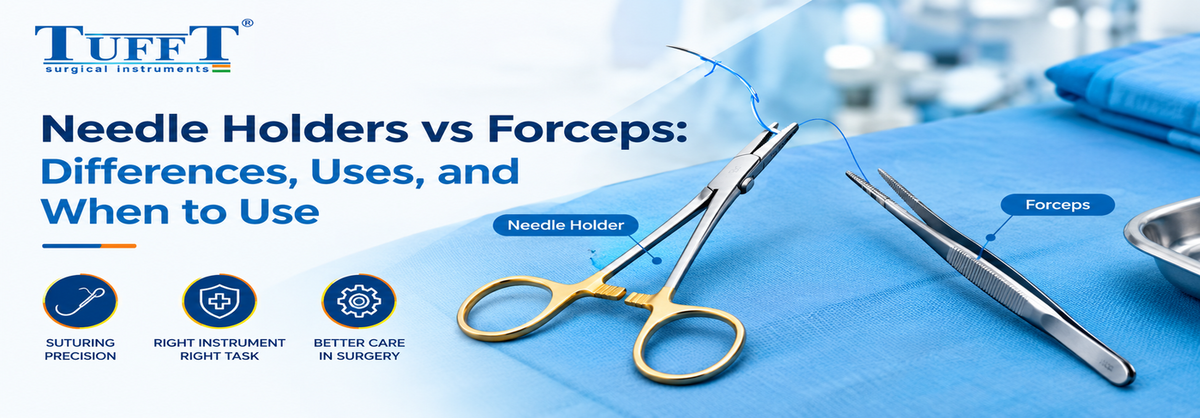
Needle holders and forceps may both have two opposing tips, but they perform different jobs. A needle holder is engineered to secure a needle during suturing, whereas tissue forceps are generally used to grasp, stabilise or manipulate tissue and other materials.
The main differences include:
-
Jaw construction: Needle holders commonly have reinforced gripping surfaces designed to hold a curved needle. Forceps may have fine teeth or smooth tips suited to tissue handling.
-
Grip and control: Needle holders often include a ratchet or another locking mechanism to maintain the needle’s position. Standard thumb forceps usually rely on continuous hand pressure.
-
Intended purpose: Needle holders guide needles through tissue, while forceps assist with tissue positioning and handling.
-
Risk of damage: Using tissue forceps to drive a needle can damage the forceps tips. Using a needle holder to grasp delicate tissue may cause unnecessary trauma.
The distinction matters in daily practice. Read more in this guide to needle holders vs forceps.
How to Handle a Needle Holder Correctly
Proper handling supports accurate suturing and helps protect both the patient and the surgical team. Instrument technique should always follow the procedure, the surgeon’s training and the facility’s established protocols.
Grip the instrument comfortably
For ring-handled models, place the thumb and ring finger through the handles while using the index and middle fingers to guide movement. Avoid gripping too tightly, as excessive tension can reduce fine motor control and cause hand fatigue.
The precise grip may vary with the instrument design and the surgeon’s preferred technique.
Position the needle correctly
As a general guideline, grasp the needle around its middle or near the junction between the middle and rear third, according to the needle’s shape and the instrument manufacturer’s instructions. Avoid gripping the needle too close to its tip or swaged end unless the design or technique specifically requires it.
The needle should sit securely across the jaws, with its curvature aligned to allow controlled rotation through the tissue. A poorly positioned needle can slip, bend or require repeated adjustments.
Apply controlled pressure
Close the ratchet only enough to secure the needle. Excessive force may damage the needle or instrument jaws, while insufficient pressure can allow the needle to move unexpectedly.
During suturing, use controlled wrist and finger movements rather than forcing the needle through resistant tissue. If the needle does not pass smoothly, reassess its angle and the tissue rather than applying unnecessary force.
Release the needle safely
After completing the required movement, disengage the locking mechanism carefully and release the needle without abrupt movements. Keep the sharp point directed away from yourself and other team members whenever possible.
Consistent passing techniques and clear communication also help reduce accidental needlestick injuries.
Cleaning, Sterilisation and Safety Precautions
A surgical needle holder is a reusable medical instrument only when its design and manufacturer’s instructions permit reuse. Proper reprocessing is essential to prevent contamination and preserve its mechanical performance.
Key precautions include:
-
Inspect before use: Check the jaws, alignment, ratchet, hinges and handles for visible damage, corrosion or looseness.
-
Clean thoroughly: Follow the validated cleaning procedure for the instrument, paying attention to joints and serrated gripping surfaces where debris can collect.
-
Sterilise correctly: Use the sterilisation method and cycle specified by the manufacturer and approved by the healthcare facility.
-
Check function after reprocessing: Confirm that the jaws align, the lock operates correctly and the instrument opens and closes smoothly.
-
Handle sharps carefully: Use approved sharps-handling procedures, appropriate protective equipment and established practices for passing and disposing of needles.
Do not use an instrument with damaged jaws, unreliable locking or visible corrosion. Such defects can compromise needle retention and increase procedural risk. Reprocessing staff should follow local infection-prevention requirements rather than relying on visual cleanliness alone.
Choosing the Right Needle Holder
Before selecting a needle holder instrument, consider the type of procedure, needle dimensions, suture material, access to the surgical site and the level of precision required. A robust Mayo-Hegar model may suit routine suturing, while a Crile-Wood or specialised microsurgical design may be preferable for finer work.
Compatibility matters, too. The jaws must hold the selected needle securely witho ut crushing or deforming it. Ergonomics, material quality, durability and the availability of manufacturer instructions should also influence purchasing decisions.
Healthcare professionals can review additional instrument information in the TUFFT blog, visit the TUFFT website or use the contact page for product-related enquiries.
Ultimately, the right instrument is one that matches the clinical task, supports controlled technique and can be maintained according to established safety standards.
FAQs
1. What is the main purpose of a needle holder in surgery?
Its main purpose is to grip and control a surgical needle during suturing. It helps the surgeon guide the needle through tissue with greater precision and stability.
2. What is the difference between a Mayo-Hegar and a Crile-Wood needle holder?
A Mayo-Hegar is generally a robust, general-purpose instrument used for routine suturing. A Crile-Wood has slimmer jaws and is often preferred when more delicate needle handling is required. The final choice depends on the procedure and needle size.
3. Can forceps be used instead of a needle holder?
Ordinary tissue forceps are not designed to drive surgical needles. Doing so may damage the instrument and provide inadequate control. A suitable needle holder should be used for its intended suturing purpose.
4. Which needle holder is best for microsurgery?
A specialised microsurgical needle holder with fine tips and precise control is generally appropriate. The specific model should match the needle, surgical site and requirements of the procedure.
5. How should a surgical needle holder be maintained?
Clean and sterilise it according to the manufacturer’s validated instructions and the healthcare facility’s protocols. Inspect the jaws, hinge and locking mechanism before use, and remove damaged instruments from service.

Team TUFFT is the editorial and expert content team behind TUFFT, dedicated to sharing insights, innovations, and industry knowledge in the field of surgical and medical instruments. Backed by experienced professionals, skilled engineers, and a commitment to quality, Team TUFFT creates informative content focused on surgical excellence, healthcare advancements, and precision manufacturing.